
On Monday I wrote about one end of the conflict scale: Artificial Harmony, where everyone agrees and nothing real is said. Today, let's move to the other end: Destructive Conflict.
You would think this one, at least, would be easy to spot. Shouting, slammed doors, open warfare. But the reality is that on most teams, it is just as quiet as artificial harmony. It isn't an explosive fight. It slowly creeps in, one small behavior at a time.
I have written before about these behaviors between two people. Here is what they look like when they take over a team.
John Gottman studied what predicts a relationship falling apart and found four behaviors, and they escalate. One leads to the next. So if we can notice the first one, we could setop the escalation.
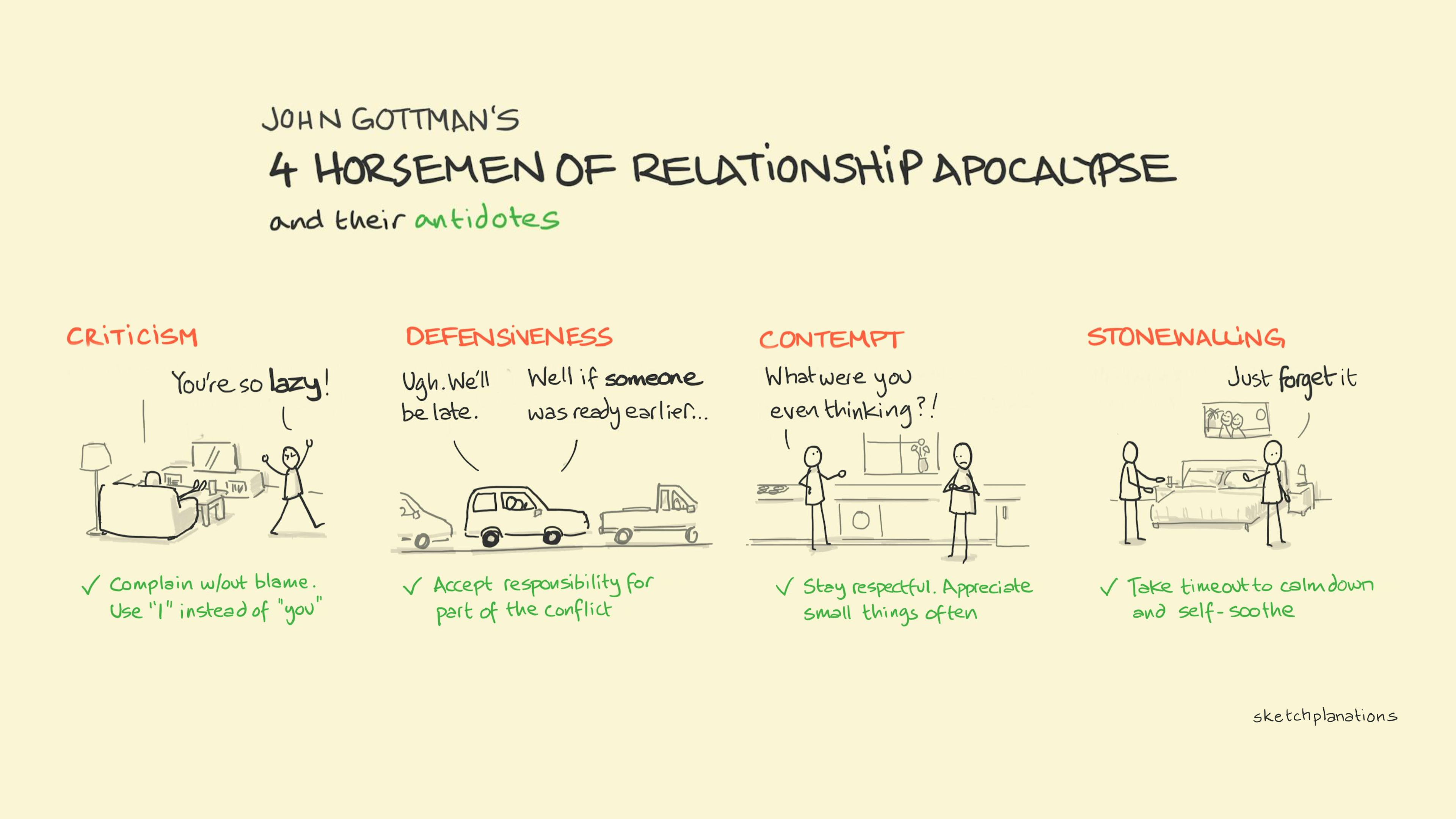
It starts here. Criticism is when the issue stops being about the work and becomes about the person.
"You are too new to know anything useful." "You are such a bottleneck." "You are stuck in the old way of doing things."
I have sat with tenured people who felt that the arrival of new hires, or a push for "fresh thinking," was really a quiet message that they were no longer good enough. Nobody said it. They felt it completely. That is the thing about criticism on a team. Sometimes it is spoken. Often it is just a perceived feeling.
Left alone, criticism curdles into contempt, and contempt is mockery. The eye-roll when someone speaks. The two people who slip off to the coffee machine after the meeting to laugh about how stupid the idea was. The "oh, there they go again."
It is the sense that some people in the room are simply beneath others. People will feel it.
Once people feel criticized and looked down on, they stop taking anything in.
A question gets met with "do you think I did not consider that?" Or "that is not really relevant, let's stay on point."
Some teammates come together to protect each other rather than engage with the actual challenge. Now no one can raise anything, because everything turns into a stand-off.
And then people just stop. On a team, stonewalling is quiet. Someone offers an idea and the response is "oh, interesting", and then the subject changes. Or it moves on with no acknowledgment at all. The idea is simply left to die.
This is why I push teams to build on each other's comments instead of changing the subject. The moment ideas stop getting picked up, people stop offering them.
Here is what connects this to Monday. Artificial harmony and destructive conflict look like opposites, but they are the same failure. In both, honest disagreement is not happening in the room. In artificial harmony it stays silent. Here, it curdles and leaks out sideways, into gossip, politics, and quiet withdrawal.
A team that "gets along" can slowly become a team that cannot stand each other. The disagreement never went anywhere. It just went underground. So both ends are broken. The healthy middle, honest disagreement about the work, is the goal.
So, how do you actually get a team there? That is where I am going next.
If this has sparked some curiosity, I would love to continue the conversation at diane@ptminsights.com.