
Last week I wrote about the quiet ways we silence the people around us, often without saying a word. This has a name. In relationship research, John Gottman identified four behaviors so corrosive he called them the four horsemen: criticism, contempt, defensiveness, and stonewalling.
I use the same framework in my team work, because what breaks trust between two people, well of course can also break trust in a team.
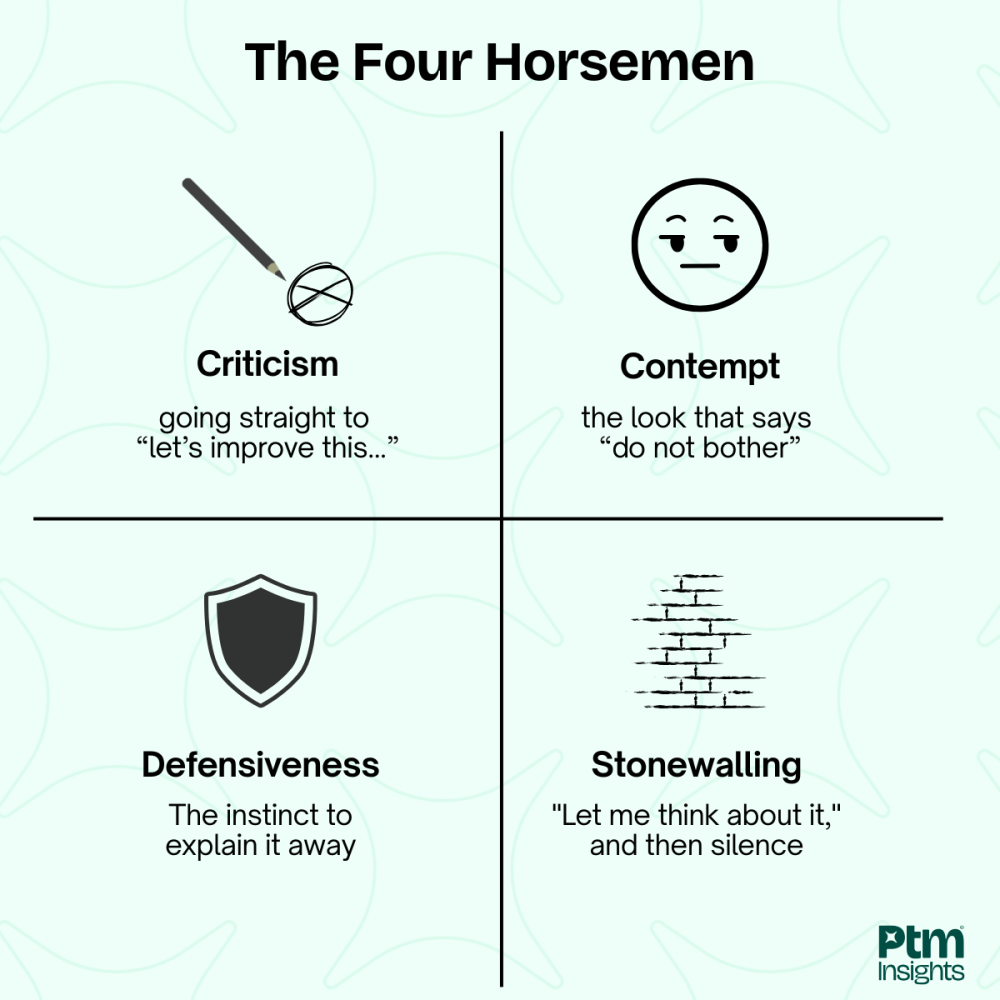
Two of them show up in how we react when someone brings us their work or their idea. Those are the two I want to look at today.
I will go first, because this one is mine.
I see what is wrong with a piece of work quickly. A gap, a weak argument, the thing that does not hold. My instinct is to go straight to it. In my head, I am only trying to make this the best it can be. That is the story I tell myself.
But here is what I have had to face. To the person who made the work, it does not feel like we are making this excellent. It feels like it is not good enough. And if every time they bring me something the first thing they hear is the flaw, they learn a quiet lesson: the work will never be good enough, so why bring my best.
The sharp eye that makes you good at the work can ALSO make people stop wanting to show it to you.
So what helps. Three things, and I am still practicing all of them:
Contempt is rarely loud at work. It is a head tilt. A small sigh. The pursed lips and the silence that follows an idea. Nothing is said, but everyone hears it. The message underneath is, "do you even know what you are talking about."
We have all been on the receiving end of it. You offer something, and a flicker of someone's face tells you it was foolish to speak. You do not make that mistake again.
The antidote is almost physical:
Both criticism and contempt are about how we receive what people bring us. Get them right, and people keep bringing things.
The harder test is what happens when someone brings you the truth about yourself. That is where the other two horsemen live, and that is Thursday.
This week, notice one thing. When someone brings you their work, what comes out of your mouth first, the strength or the flaw?
If this has sparked some curiosity, I would love to continue the conversation at diane@ptminsights.com.