
Over the years, I have heard many organizations describe the leader they do not want. The words are always similar: "someone who bulldozes". Someone who says “I am the boss, I run this.” Someone who limits people’s exposure and controls the room.
Here is what I have come to believe: most leaders who come across this way are not hungry for power. They are just talking too much.
Pay attention to what fills a leader’s airtime, and a pattern appears. It is almost all expectation: what needs to get done, who should do it, where we are going. It is business, vision, and clear opinions. Sure, leaders need to have opinions, but when a leader believes too strongly in their vision, the belief itself blocks out other voices.
So people tend to go silent. They conclude that this leader does not value their opinion. And here is the harsh part: they are often right.
I know, because I have been the "talks too much" leader. I am admitting it to you - I took opinions from the people I already valued, and I had clear opinions on the vision. I did not think of myself as controlling. I just had a lot to say about where we were going.
That is the honest scorecard of my early attempts. I believed I only needed to say: this is where we go, this is how you do it. But there were things I did not know about their jobs and their challenges. And I was asking something bigger than I realized: to shift from a role identity they had lived in for years to one they had never experienced. That is genuinely scary, and scared people do not move because the vision sounds right.
Changing this starts with noticing what our listening actually is. Here is the difference:
Fake listening, at its simplest, is looking at the person while planning what you will say when they stop.
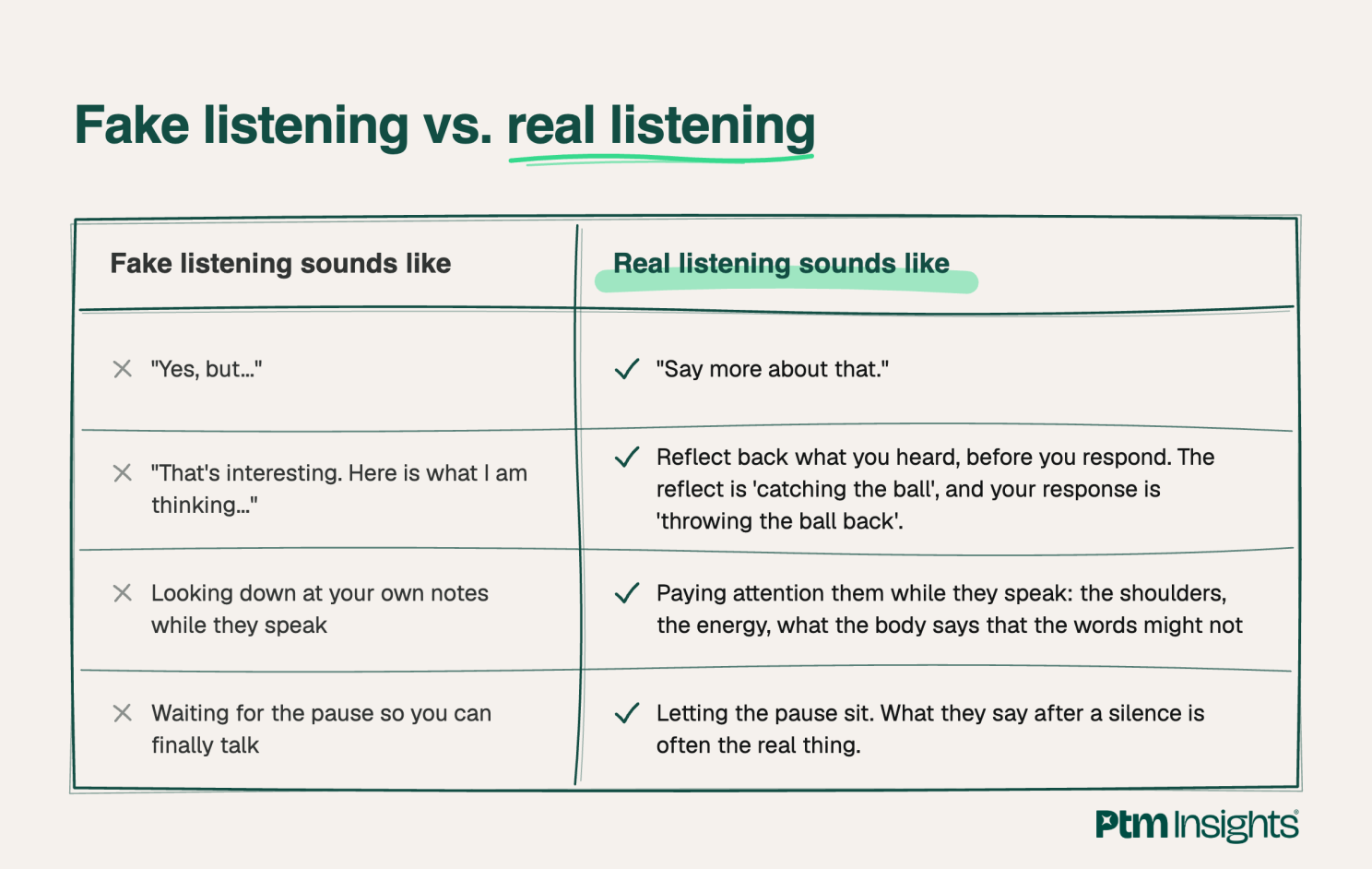
What I learned to do with a vision: do not share it yet. Instead, talk to each person first:
Then, and only then, work out how the vision connects to what they want. Most of the time, you discover you want the same thing. Sometimes, you discover your implementation needs to change. Occasionally, the vision itself does.
I have asked myself this. It is only manipulation if nothing they say can change you. If every conversation is designed to arrive at the plan you already finalized, people will eventually feel it. But if you are listening because they know things you do not, the conversations are real. Here is the test:
After the listening, can you name something that changed because of what you heard? If the answer is nothing, you were not listening. You were selling.
For a leader entering a new team, or restarting with an existing one, I now believe in a simple ratio: listen 80, talk 20. In the first conversations, make it 90/10.
The people waiting for a new leader are all quietly asking one question: "what will this person do for me?" You cannot answer it by talking. You can only answer it by asking with genuine curiosity.
If this has sparked some curiosity, I would love to continue the conversation at diane@ptminsights.com.