
For the last while, I have been writing about 1:1 relationships. Trust between two people. Self-orientation. The relationship that seems fine being the one worth checking.
Now I want to turn to the group, because a team is not just a stack of good 1:1 relationships. A team has its own behavior and one of the most important things about any team is whether it can actually disagree.
Conflict tends to cause us to flinch. We picture tension and hurt feelings, so its natural that we avoid it. So let me offer a different frame, one I learned at McKinsey. There, we were taught to fall in love with the problem before reaching for any solution. Not the answer. The problem.
We can only fall in love with a problem once we truly understand it. That means hearing every issue, every angle, everything each person in the room is noticing. One person sees one part. Someone else sees another. The full picture only appears when all of it is on the table.
And so, this also means that disagreement is not a threat to the work. It is how the work gets done. If everyone agrees right away, we have not understood the problem. We have just fallen for the first solution.
Patrick Lencioni describes team conflict as a scale. At one end, artificial harmony, where everyone is pleasant and nothing real is said. At the other, destructive conflict, where it gets personal and political. In the middle sits the healthy zone where there is honest disagreement about the work, not the people.
Here is the part most people miss. Both ends are dysfunction. We are trained to think the opposite of nasty conflict is a calm, agreeable team. It is not. A calm, agreeable team is often just sitting at the other broken end of the scale.
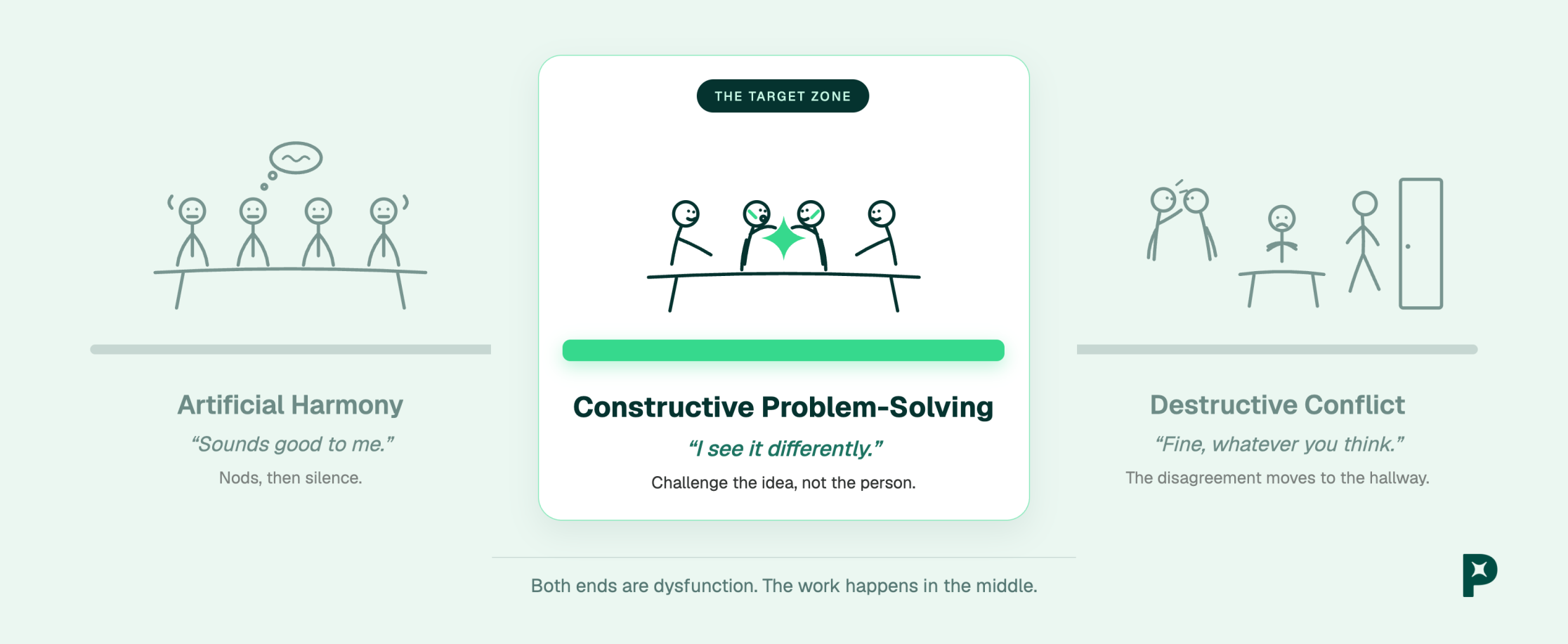
A team where everyone agrees is not free of conflict. It has just buried it.
A team where everyone agrees does not actually have less conflict. The disagreement is still there. It has simply gone underground - buried inside each team member.
It looks completely fine from the outside, which is exactly why it is missed.
You leave the room feeling pleasant and slightly unsure anything was actually decided. That is not a healthy team. That is a team that has stopped telling each other the truth, in the most polite way possible.
When I run this with a team, I print the scale and give everyone a copy. Each person marks where they think the team sits, privately, on their own sheet. Then all the dots go up on the wall at the same time.
I do it that way for a reason. If I asked out loud, people would just agree with each other about whether they agree too much. Done independently, you see the truth: usually a spread, and where each person places themselves often says as much about whether they feel safe to speak as it does about the team. You cannot put dots on a wall by yourself. But you can ask yourself one honest question:
When did someone last openly disagree in one of your meetings?
If you have to think hard about it, you already have your answer.
On Thursday, the other end of the scale, and why it is just as quiet as this one. If this has sparked some curiosity, I would love to continue the conversation at diane@ptminsights.com.