
Some want more of it. Some are struggling to work with people they cannot trust. And for the most part, we assume trust is simply a function of time. Someone shared a statistic with me recently that stuck.
A company had looked at how long it took new hires to feel trusted, and the answer was about a year and a half.
Imagine that... Eighteen months at a new job, waiting to be trusted.
So the question they put to the group was the right one. How do we make that faster? What are the intentional moves that build trust, rather than waiting for it to naturally arrive?
Time helps, but plenty of people work alongside each other for years and never get there. Trust is not something that accumulates while you wait. It gets built, and you can build it deliberately. The other thing most of us believe is that trust comes from doing good work. Deliver, deliver, deliver, and people will trust you. That is not quite true either.
There is a formula I come back to often, from a book called The Trusted Advisor. It looks like this:
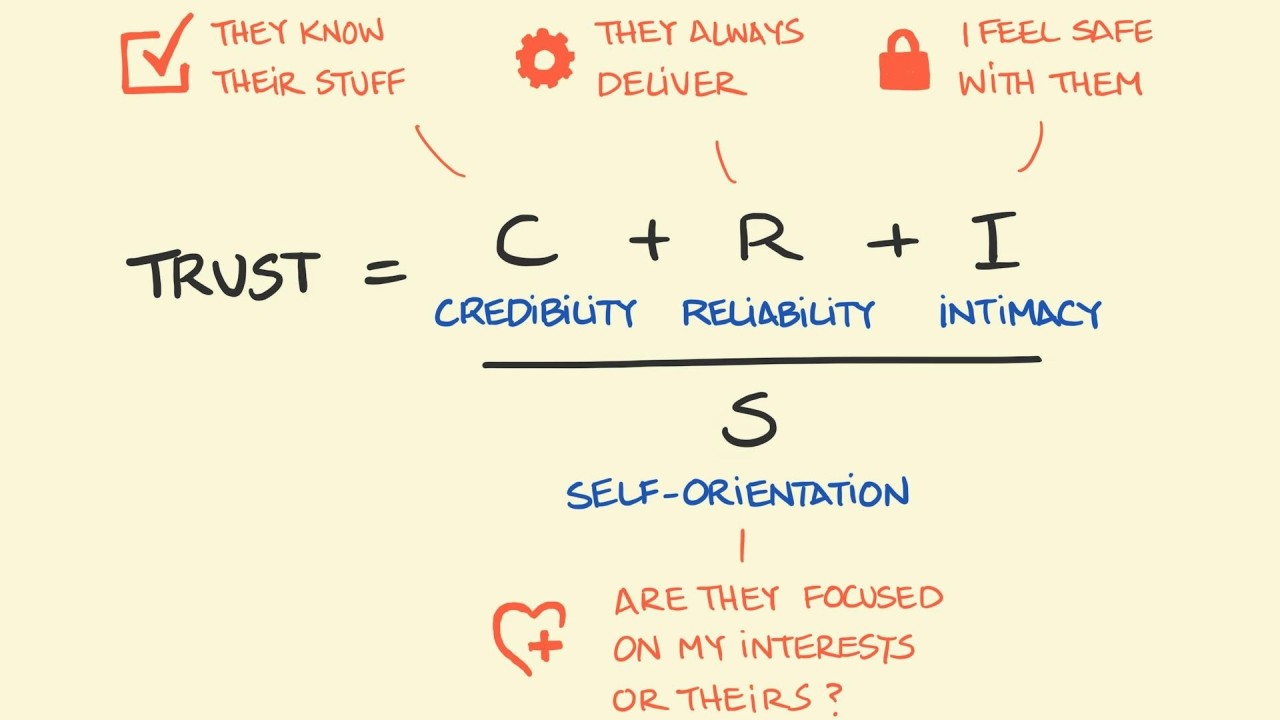
Most people, when they see it, nod and move on. It stays a piece of theory. What I find more interesting is what each part actually looks like from the outside, to the person deciding whether to trust you. Because they are not judging you on the big, obvious things. They are judging you on the small ones.
This is not just whether you really know what you say you know. It is whether you know what you do not know. Nothing costs credibility faster than over claiming. The person who has an answer for everything, who never once says “I am not sure,” is not building credibility. I recently ran a 360 feedback, and the providers said to me,
"The person acts like they are the expert, but sometimes I wonder - is it just overconfidence?"
We think this is about delivering the big things. It is not. People judge reliability on the small ones. You may have delivered a huge project on time. But you are the last to arrive in a meeting. Sometimes the reply is fast, other times it requires multiple follow-ups. People like a predictable person. People are not being petty. The small things show what you actually prioritize, and perhaps, the big things, well, those had to happen anyway. People trust patterns, not the one or two highlights.
This is the one leaders skip and it is not what people think it is. It is not friendship. It is not telling everyone about your weekend. Intimacy is whether people feel safe being honest with you (remember when I talked about vulnerability-based trust?). Can they bring you a problem, a doubt, something they got wrong? And here is the thing, you do not build it by announcing that your door is always open. You build it through the everyday conversation and by what you actually do the moment someone tells you something hard. That is when people find out whether it was safe or not.
Here is what makes the equation so useful, and so uncomfortable. Self-orientation is the denominator. It divides everything else. You can be credible. You can be reliable. You can be warm. And if the other person senses that all of it is ultimately in service of you, of what you need, of what you are trying to get out of this, then it collapses anyway.
You can ask someone how they are and have them come away feeling interrogated rather than cared for. More on that another day. People feel this. They usually cannot explain how they know. But they know.
Think of one relationship where you want more trust and run it through the equation. Most people assume the answer is credibility or reliability, that they need to prove themselves more, deliver more, know more. It usually is not. More often it is:
Sit with which one it actually is. It might make you uncomfortable, which then means you have arrived at the real answer.
I want to spend some time on this, because trust gets built far more deliberately, and far more subtly, than most of us realize. It is not the grand gesture. It is what you do in a fifteen-minute conversation on a Tuesday. More soon.
If this has sparked some curiosity, I would love to continue the conversation at diane@ptminsights.com.