
On Monday I wrote about two of Gottman's four horsemen, criticism and contempt, the ways we shut people down when they bring us their work.
Because they show up when someone brings us the truth about ourselves.
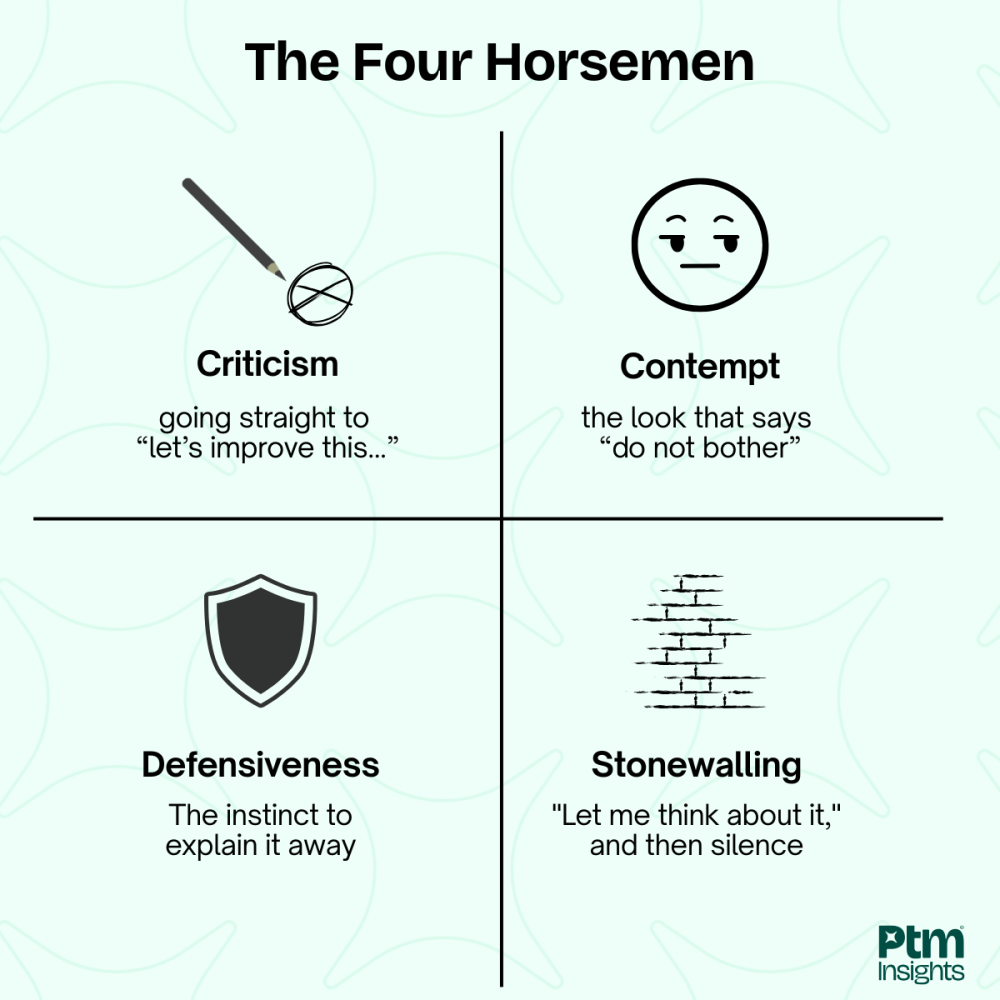
Someone finally tells you something difficult. "You are too slow to decide." "The team does not trust you." And before they have even finished, you are already explaining. "There was a reason." "They do not have the full picture. It is not really like that."
It rarely looks like an argument. It is quieter than that.
And the feedback provider learns the lesson fast: there is no use telling this person anything, they will always have an answer.
I once watched a group of leaders receive hard feedback from their team. Their first instinct was to defend. "It is not fair. The team is underperforming." And the truth was, the team was underperforming. But that was not the point in that moment. The point was that no one trusted them, and every defense made it worse.
The moment you explain, the other person stops talking. The moment you own one true thing, they start.
The antidote is simple and very hard. Find the one part that is true, and say that first. Not the whole thing. One part. "You are right, we were too slow, and that is on us." The instant you take one honest piece, without a "but" attached, the temperature drops. You have shown it is safe to tell you the truth, because you did not run from it.
Stonewalling at work is not the silent treatment. It is quieter and more polite than that.
The person does not feel attacked. They feel something worse. They feel like their words disappeared. And so they stop spending them.
The antidote is to close the loop. Go back, and tell them what you did with what they said, even when you did not act on it. "I thought about your point on the timeline. I appreciate your feedback and you made some good points. I am not going to change it, and here is why." That takes two minutes, and it teaches people the opposite of disappearing. It teaches them they were heard.
I once worked with a leader I was unhappy with. I went into a difficult conversation braced for him to defend himself. Instead, he took out a notebook.
He said, "I am here to listen."
And then he wrote, and wrote, and wrote some more, the entire time while I spoke. He did not interrupt. When I finished, he reflected back what he heard. He did not defend a single thing.
I walked in guarded. I left more open than I had been in months.
That is what receiving the truth looks like. No shield. No vanishing. Just a person willing to hear the hard thing and stay in the room.
These four horsemen decide something quietly enormous: whether the truth ever reaches you at all.
You will not master them in a week. But the next time someone tells you something hard, try one thing.
Before you explain, find the one part that is true, and say that first.
If this has sparked some curiosity, I would love to continue the conversation at diane@ptminsights.com.