
On Monday I wrote that feedback is data, not a judgment of who you are. But it only feels like a judgment when our sense of who we are is on the line, and nowhere is that truer than after a long run of success.
A leader I know moved from a business he had run brilliantly for years into a new one. Same company, bigger role, a natural next step. Within months he was struggling, and he could not understand why. The instincts that had always worked were not working. His confidence started to slip, and quietly, he began to wonder if the new business was simply broken.
It was not broken.
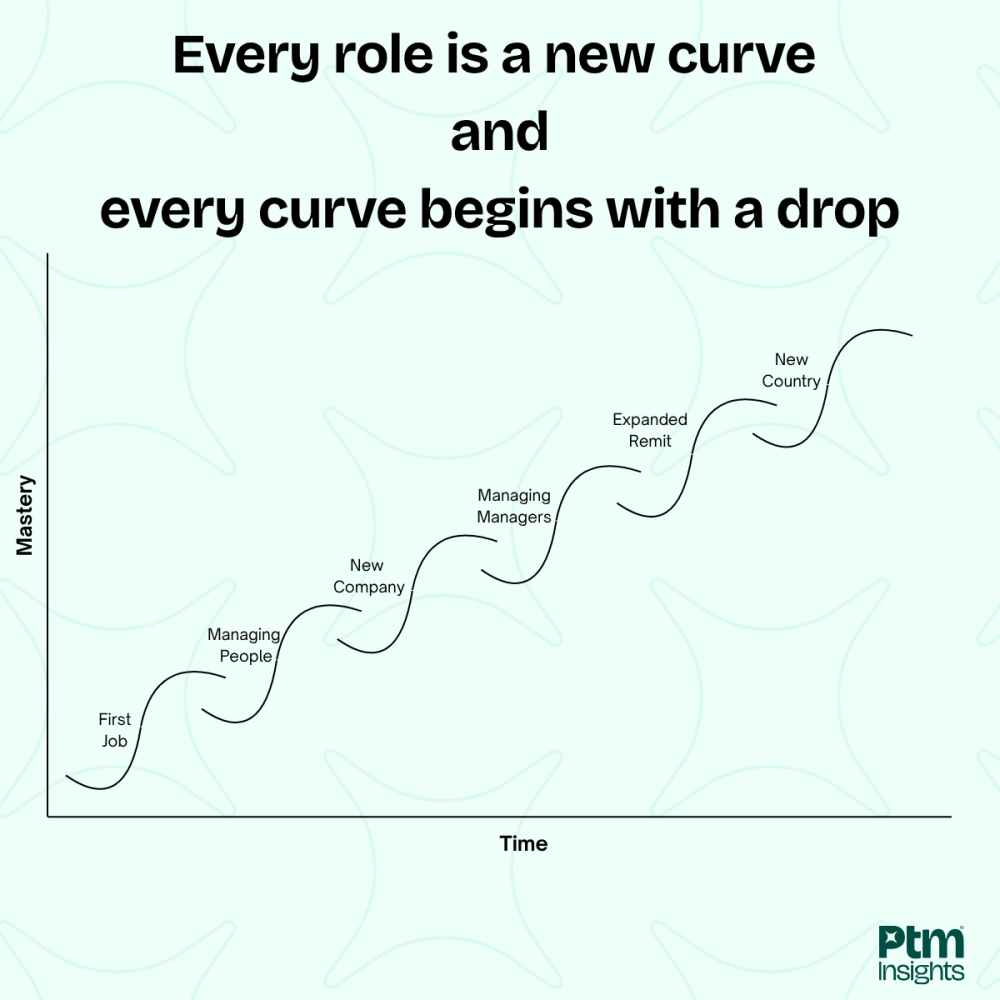
If you have spent time in business, you know the S-Curve. You start something new, and at first you drop. Not because you are failing, but because the skills that made you excellent no longer fully apply, and new ones take time to build. For a real period, you are not the top performer you were. Then the new skills come, you accelerate, and you climb into mastery. It feels wonderful to be good at something again.
But you cannot stay at the top. The world keeps moving, and eventually every curve flattens and begins to fall, unless you are willing to step onto the next one. And stepping onto the next curve means accepting the drop all over again.
Here is what most accomplished leaders miss. They assume a new country, a new company, a move from a consumer business to enterprise sales, is a continuation of the same climb. It is not. It is a new curve. And the only way up is to go through the drop first.
The drop asks you to do the one thing success makes hardest. To be a beginner again.
The more senior you become, the more your sense of who you are is tied to being capable, being right, being the one with the answers. So the drop does not just feel uncomfortable. It feels like a threat to your identity. Admitting "I do not know how to do this yet" sounds, somewhere underneath, like admitting "I am not who I thought I was."
So we avoid the drop.
We decide the new place is strange, or the people do not get it, or the old way would work if everyone would just adapt to us.
Anything rather than accept that we are at the bottom of a new curve, with new skills to learn.
This is the quiet trap of success. The very mastery we are proud of becomes the thing that keeps us from climbing higher.
I say this as someone who has lived it. I have made these jumps myself, across countries, firms, and functions. Each time, I had to accept that I was back at the bottom, knowing less than the people around me, needing skills I did not yet have. It is humbling every single time... and trust me, there are times I refused to accept, and so I failed so very hard.
Recently, I spoke with a leader who said something most leaders never say.
She told me she had learned she needed to have no ego in order to grow.
Because without that, she could not truly take in feedback or learn anything new, and if she could not do that, she could not become any better than she already was.
No ego does not mean no confidence. It means being willing to not know. To be a beginner. To hear "you have not got this yet" and respond with curiosity rather than defense. In ORSC, there is a principle I return to often. Everyone is right... partially. The people around you, even the ones whose feedback stings, are partially right. So are you. The drop is where you find the part that is true, and build from it.
That willingness, to set the ego down and accept the drop, is not weakness. It is the most demanding form of strength there is. And it is what every new curve quietly requires of us.
So here is what I would ask you, the same question I ask the leaders I collaborate with.
What is your next S-Curve? And are you willing to accept the drop it asks of you, or are you holding on to the top of a curve that has already begun to fall?
If this has sparked some curiosity, I would love to continue the conversation at diane@ptminsights.com.