
In my last article I wrote about the cup we have all been drinking from, filled with the values and beliefs poured into us before we had the wisdom to choose them.
But when most leaders finally look, they find something they did not expect - there is already feedback sitting in there:
And most of us have done one of two things with it. We 1) ignored it or 2) we let it overwhelm us so completely that we never actually digested it.
Both feel like self-protection, but in reality, both keep us exactly where we are.
When feedback arrives, very few of us pause to examine it. We react immediately, often before we even realize it.
I once worked with a leader whose team told him his vision was inspiring, BUT he was moving too fast that no one could keep up. They felt dragged behind a car speeding down the highway. This was useful feedback. A gift, even. But his first reaction was not to look at it. He defended himself,
"They are too slow. I was hired to move fast. They need to get into the car or get off the highway."
I mean - truly, this is the "my way or the highway" in action.
I worked with another leader whose team expressed frustration that 1on1s were cold status updates from them to him. They felt he didn't know what they were working on. They requested he build on what he already understood, and ask about what he didn't. They were asking to be led better. Yet the feedback landed as criticism. His instinct was that they were hiding their unproductivity. And besides,
"Isn't it normal for employees to update their boss?"
What strikes me about both is that the feedback was good. It was exactly the kind of insight most leaders say they want. And still, the instinct was to deflect, to rationalize, to defend. Not because these were poor leaders, but because all of us do this when feedback feels like a judgment of who we are, rather than information about how we land.
Let's be honest, many of us have received similar feedback. Did we react any differently?
We deflect because feedback feels personal. If someone says I move too fast, it does not feel like information about my pace. It feels like a statement about whether I am a good leader. So we protect ourselves, either by dismissing the feedback or by drowning in it.
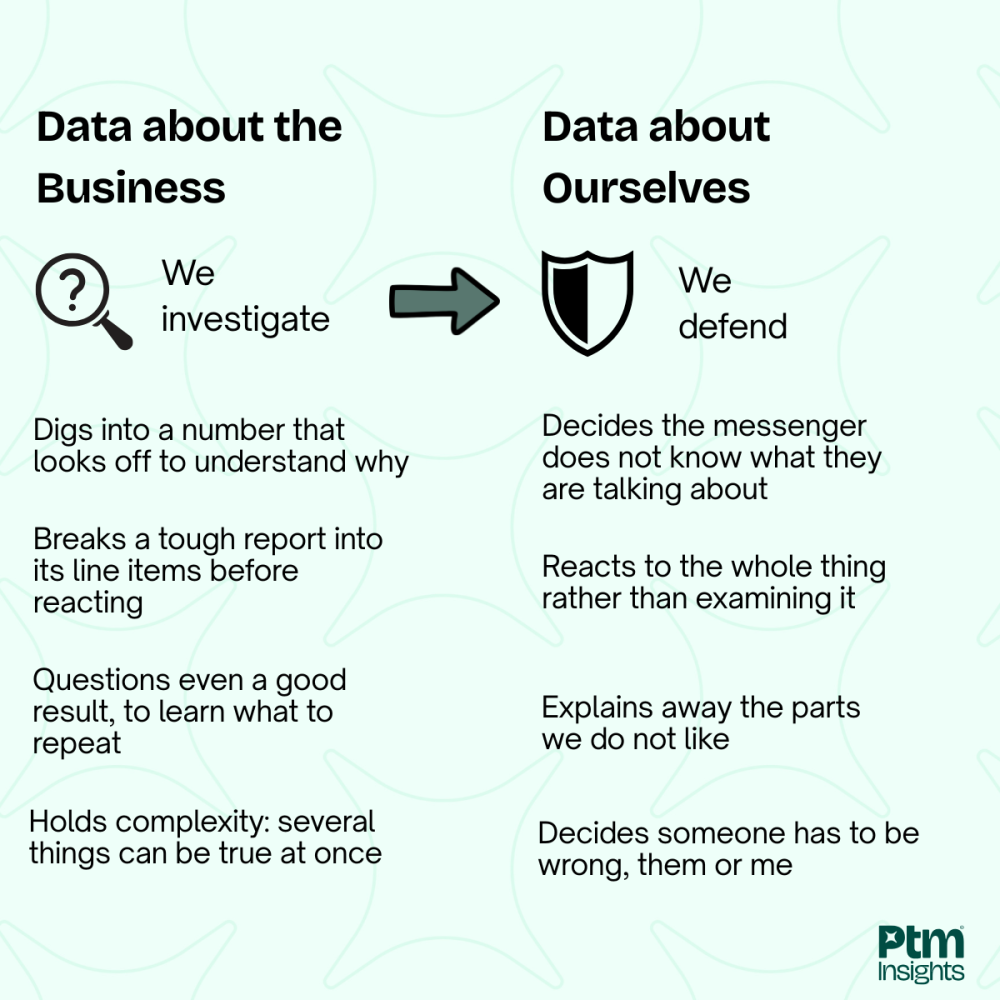
But we would never treat any other data this way. When a tough financial report lands, a good leader does not panic or look away. They dig into it, break it into its parts, and work out what is signal and what is noise. They even question a good quarter, because they want to know what drove it (was it luck or was it intentional effort?) and whether they can repeat it.
The strange thing is that the moment the data is about us, rather than about the business, all of that discipline disappears.
Feedback is simply data about how we are perceived. Like any other data, it is meant to be examined. Not swallowed like a tight lump in our throat, and not turned away like a salesperson at the door.
When I work with leaders on their feedback, my role is to help them see the themes. We do not react to any single comment. We look for what shows up again and again, and we set aside the outliers, the way you would in any honest analysis. One person's careless comment is not the pattern. The pattern is what most of the data is telling you.
Because not all feedback deserves to be kept, at least not in the way it first arrives.
I once knew a leader who was told his smile looked fake, and then could not smile naturally for months because he kept thinking about it. I was once told, in my written feedback, that the way I look when eating ice cream is irritating. It came right after a separate comment that I was uninspiring and should not be promoted, and I could not disconnect the two.
Some feedback is like that. Almost pure noise.
But other feedback is trickier, because it hides something true inside a story that is wrong. I was once told I played favorites, because I always greeted the same person first thing in the morning. The truth was simple. They sat right by the front door, so they were the first person I saw. The favoritism story was wrong. But buried inside it was something I needed to hear. On a team of more than fifty people, others noticed they were not greeted by name, and they felt overlooked. The interpretation was noise. The impact was signal. And I would have missed it if I had dismissed the whole thing as unfair.
That is the real skill. Not blind openness to everything, and not defensive rejection of anything that stings. It is the discipline to examine what arrives, separate the story from the signal, and consciously choose what to keep and what to set aside.
Self-awareness starts with knowing how others perceive us, whether we like it or not. So the honest question is this.
How self-aware can you truly become if you never gather the data on how you are actually viewed?
The feedback is already in your cup. The only question is whether you are willing to look at it, calmly and with curiosity, and decide for yourself what it means.
If this has sparked some curiosity, I would love to continue the conversation via direct message. Please do email me at diane@ptminsights.com.