
In my last article I introduced vulnerability as the leadership capability that multiplies everything else you do. But here is the thing about vulnerability — you cannot offer what you have not yet examined in yourself. Which brings us to the most overlooked starting point in leadership development:
Not the kind that comes from a personality test or a one-day offsite. The kind that comes from genuinely examining who you are: where your patterns came from, what shaped how you see the world, and whether you have ever truly looked at any of it.
In most of my coaching sessions, my client and I are sitting together over a cup of coffee or water. I ask them to look at the cup in front of them. Imagine this is a metaphor for your values and your decision-making. Most of us have been drinking from the same cup for so long we have never stopped to ask what is actually in it. We assume it is just water. Clear. Unexamined. Ours. Coaching is where we finally look."
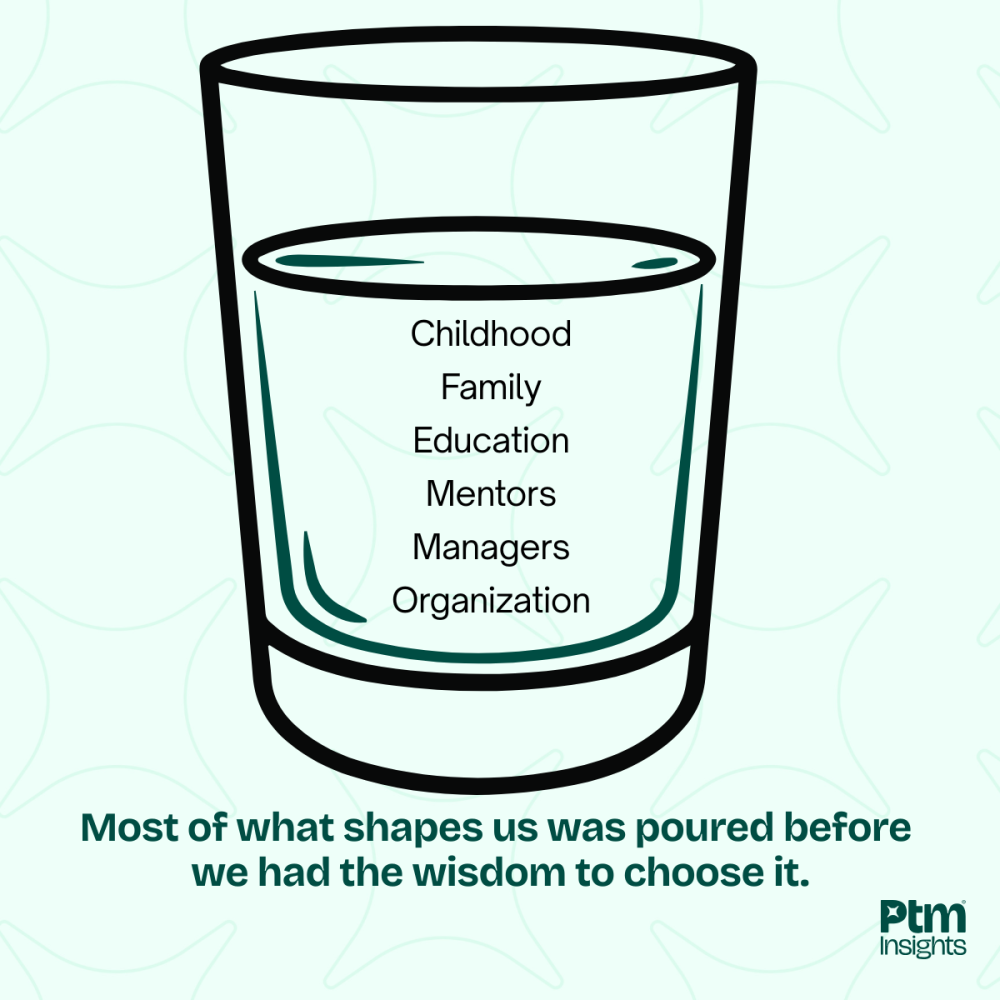
Robert Kegan's work on adult development has deeply shaped how I think about leadership growth and he describes this as the socialized mind: an identity constructed from the systems around us rather than from our own internal compass. Family. Education. The managers who first showed us what leadership looked like. The mentors whose voices we internalized. The organizations whose cultures became our cultures without us ever choosing them.
Most of what is in the cup was poured before we had the wisdom to choose it.
The work of self-awareness is not about emptying the cup. It is about looking into it clearly: seeing what is there, where it came from, and whether you are still drinking it by choice or simply by habit.
In my coaching work, I use the Leadership Circle Profile (LCP), a developmental 360 assessment, that surfaces patterns most leaders have never seen clearly before. Before we look at the data together, I ask the leader three things.
What happens next is always the same. The leader tells their three stories. Then we look at the LCP together. And without me pointing anything out, they start to see it themselves.
The pattern that shows up in the data was already there in the stories. It was there in childhood before it had a name. It was there in early career before it became a professional habit. And it's there right now: still running, still shaping decisions, still organizing how they experience the world.
That is what was in the cup. And seeing it across three key moments of your own life is one of the most clarifying ... and most humbling... moments in any coaching engagement.
You do not need an LCP to begin. You just need three stories and two honest questions.
For each story, ask yourself:
Most leaders find this exercise easier to begin than they expected and harder to complete than they anticipated. Seeing the thread requires a kind of honest distance that is genuinely difficult to create alone. Which is why the most important insights from this exercise almost always happen in conversation, not in isolation.
Once you have sat with your three stories, take one more step. Go to Brené Brown's values list from Dare to Lead. Pick your two core values. Not the ones you think you should have. The ones that have actually been running your behavior (in all three of your stories).
There are no right or wrong values on this list. The only question worth asking is:
Are these values truly mine... or were they poured into my cup before I had the wisdom to choose them?
That question does not need to be answered today. But giving it space is the beginning of something important.
In my next article I go deeper into what it actually looks like to show up as yourself (not a version of yourself) in the professional contexts that matter most.
If this has sparked some curiosity, I would love to continue the conversation at diane@ptminsights.com.