
The usual starting point is a leadership team: cross-functional or cross-departmental managers, at any level, each running their own team. Everyone sees themselves as a leader of their people. What they often do not see is that this team, the one they sit on together, matters just as much. Possibly more.
The symptom is usually misaligned goals. Each member carries their own KPIs, not quite connected to the leader's larger goal, and everyone gets on with their own work. There might not be a burning fire. But the leader has an intuitive sense:
with real collaboration in this team, the impact for our business and clients would be far greater.
It also fits certain teams of individual contributors: people who must make decisions together and currently cannot, where collaboration is strained, trust is thin, or each person holds a different view of what matters most in the work.
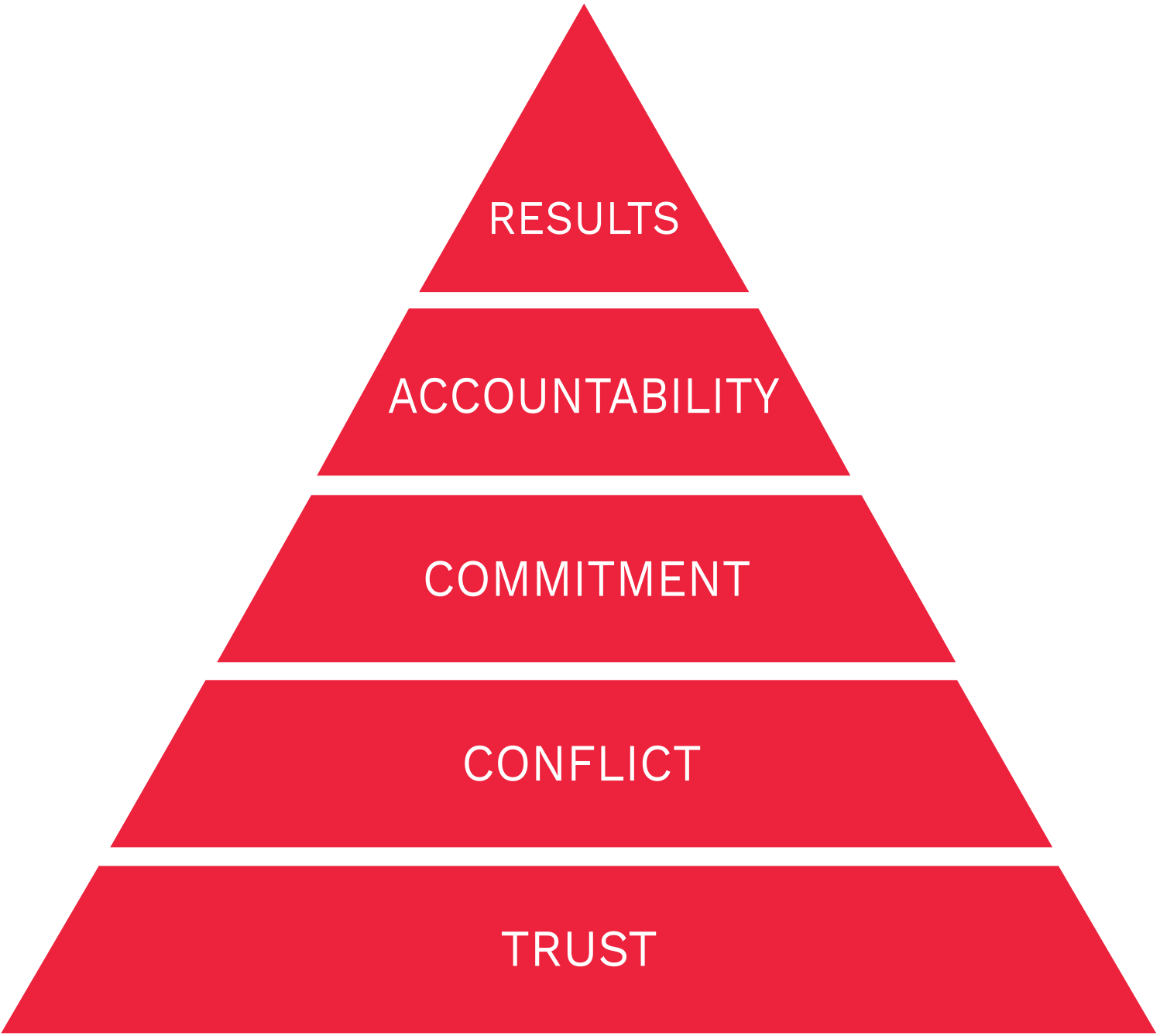
The Five Behaviors of a Cohesive Team is built on Patrick Lencioni's model of how teams actually become high-performing. It describes five behaviors that build on each other like a pyramid: trust at the base, then healthy conflict, commitment, accountability, and collective results at the top. A team cannot skip levels. Without trust, people will not debate honestly; without honest debate, commitment is surface-level; and so on up the pyramid.
Each team member completes an assessment, and the team receives a report of roughly 36 pages, written specifically about this team: scores for each behavior, team-specific narrative, and comparisons against the thousands of teams that have taken it. For many teams, this is the first time they have ever seen themselves measured as a team rather than as individuals.
A leader often comes to me feeling the "too many different priorities" problem. The assessment usually reveals what sits underneath it: trust is more transactional in nature, or conflict is being avoided in group discussions. A team that never argues is not aligned. The side conversations are happening outside of the room.
Discovery conversations come first, with each team member. And I work closely with the leader on something more: identifying a real vision or priority that matters right now. Together, this shapes how we spend the time together.
In the room, I do not present the results as a PowerPoint. The team's results go up as posters on the walls, alongside anonymized comments from the discovery conversations, and people walk through them at their own pace. Something different happens when a team walks through its own data rather than watching it on a screen: they stop being an audience and start being participants. Imagine an art gallery you walk through.
What the walls reveal, I coach the team to reflect on. Sometimes everyone has been feeling the same thing, and saying so out loud is itself a release. Sometimes two groups have been experiencing the same team completely differently, and a divide everyone sensed, but nobody named, is suddenly visible. Either way, the team now sees itself clearly, and has language for what it sees:
this is what trust really means, this is how we currently debate, and this is how we want to.
Then comes the reason for all of it: The offsite is not separate from the real work. It is embedded in it.
We build up the pyramid so that the team can use it, in the room, on the real priority the leader and I identified. This is where the day becomes theirs: I design the strategy conversation around what is actually happening in front of me. A group that prefers harmony and avoids open conflict does not get a big open debate; they work in pairs and trios, putting ideas and concerns on the wall, where honesty costs less. The format adapts so the conversation can happen.
I hold certifications in both, and I regularly tell teams which one they do not need yet. The Five Behaviors suits teams that must decide and deliver together: leadership teams, or interdependent groups whose results depend on each other. If the team simply wants to connect more deeply and understand how each person works, that is foundational work, and Everything DiSC is the better fit. DiSC is actually built into the Five Behaviors journey, so the two connect naturally.
More on teambuilding with DiSC here.
After the session, I share a post-session reflection memo, summarizing the time together, and providing suggested actions the team can take forward on their own. True sustained changes rely on the leader and the participants to commit to each other, and so I am also available for that ongoing team coaching as well.
Languages
I facilitate in English, Cantonese, and Mandarin. For teams in Japan, the assessments and reports are available in Japanese, so participants can take and read everything in their own language, and I bring key terminology in Japanese. Posters and other content are multi-lingual if it benefits the participants. Sessions work well in English-comfortable teams and mixed-language rooms. For teams needing full delivery in Japanese, I partner with a Japanese-speaking associate coach.