
Most organizations respond to rising mental health concerns the same way. Awareness sessions. An app subscription. A reminder that the EAP exists and is confidential and is there whenever you need it.
These things matter. They are not wrong. But they rarely reach the place where the change actually needs to happen: with the leaders whose daily behavior determines whether a person feels safe enough to say they are struggling.
This is an account of work I have led where we started somewhere different.
The leadership team had data. They looked at it regularly. What they saw was this:
People going on sudden leave of absence, with no clear explanation why. Those people gone for months, then an HR notification that the individual had voluntarily resigned. Newer employees leaving earlier than anyone expected. Upward feedback about managers that was consistently, almost implausibly, positive. An annual survey showing high satisfaction alongside workloads everyone acknowledged were unsustainable.
What employees were living was a different thing entirely.
Workloads beyond sustainable capacity, understood as simply the price of the profession. Everyone above them had come through it the same way, so the difficulty was normal rather than a signal.
Struggle read as weakness. Going on leave was understood as poor performance. Not finishing on time was understood as poor prioritization.
And no visible signal. Leaders asked how people were doing. They were friendly, and they meant it. But nothing in the environment told anyone it was safe to speak, to slow down, or to ask for help. There were no role models of successful recovery, because nobody who had recovered had ever said so.
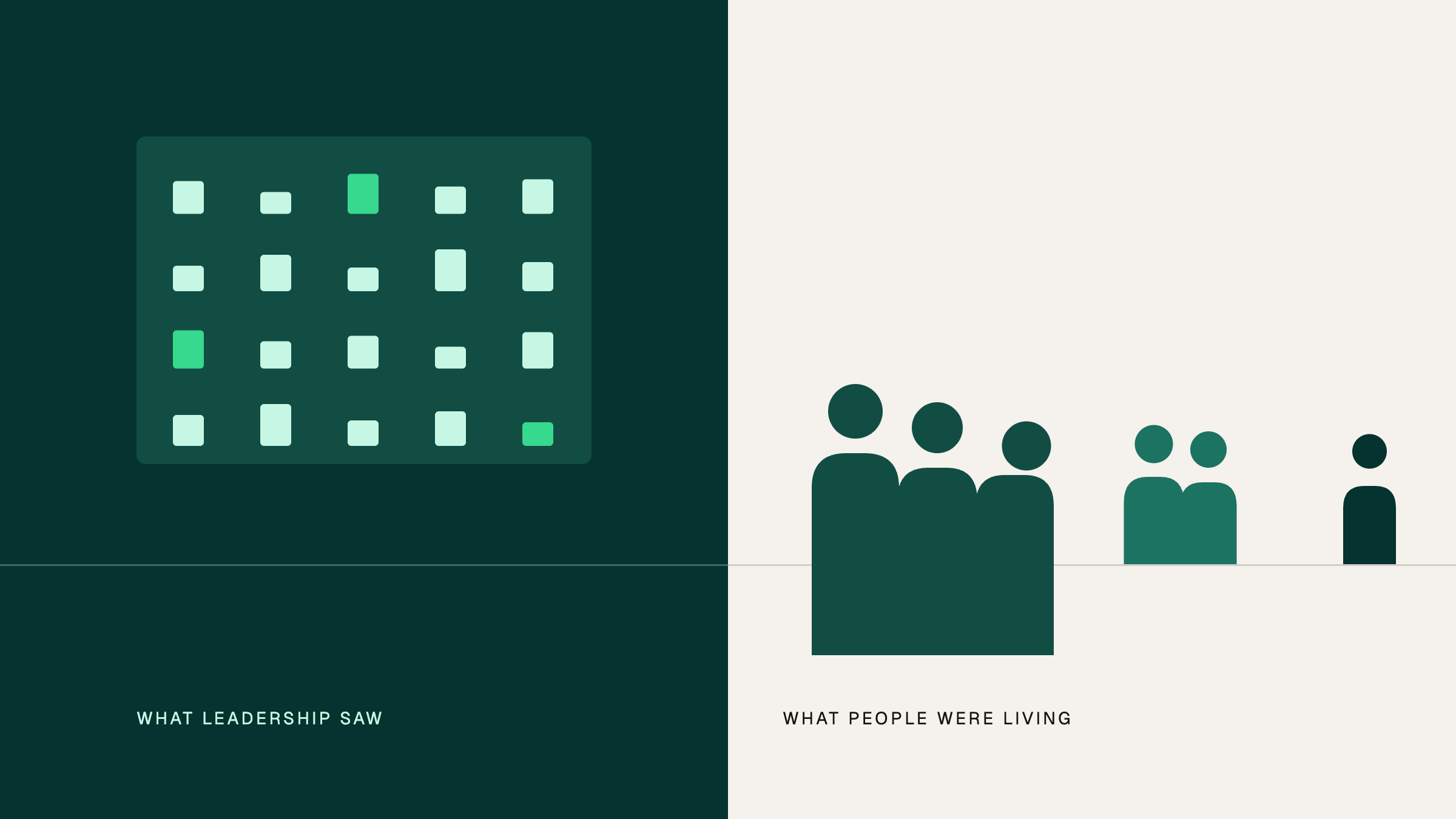
The gap between these two realities was not a failure of care. Every leader in that room cared. It was a failure of visibility.
Here is the thing that took me a while to understand.
The leaders had seen most of this data before. Attrition figures. Leave patterns. Survey results. Open-text responses. None of it was new information.

Data shows you what is happening. Stories show you what it feels like to live it. Most organizations have one without the other, and the one they have is the one that does not change behavior.
Knowing that people are struggling produces a policy. Feeling what it is like to be that person produces a different quality of attention entirely. The work was not about generating new information. It was about closing the distance between knowing and feeling.
We began with what the organization already had, and we brought it into a room with the leaders rather than sending it to them.
They challenged it immediately, which was the point.
Surely these are the poor performers. Surely this is a gender pattern. Surely it is the junior people who cannot cope yet.
None of those held. The people struggling most were among the strongest performers. There was no meaningful gender difference. The concentration sat with people who had been there long enough to be trusted with more, and with those who had recently become managers.
Each answer took away an explanation that would have let the room set the problem aside. By the end of that exchange the leaders had arrived somewhere they had not been fifteen minutes earlier:
this is real, it is significant, and it is heading for business impact.
Then we told one story.
Working with the organization's wellbeing provider, and without breaching any confidentiality, we had identified the common shape of a leave case. The symptoms had appeared months before the leave. Counselors had encouraged early rest and recovery. People declined, because taking rest would mark them as someone who could not handle the work.
A treatable condition became a serious one, because of what it would have cost to treat it early.
We told that as a single anonymous story. It took five minutes.
Curiosity first: a genuine appetite to hear more, to understand the mechanism, to work out how to solve it.
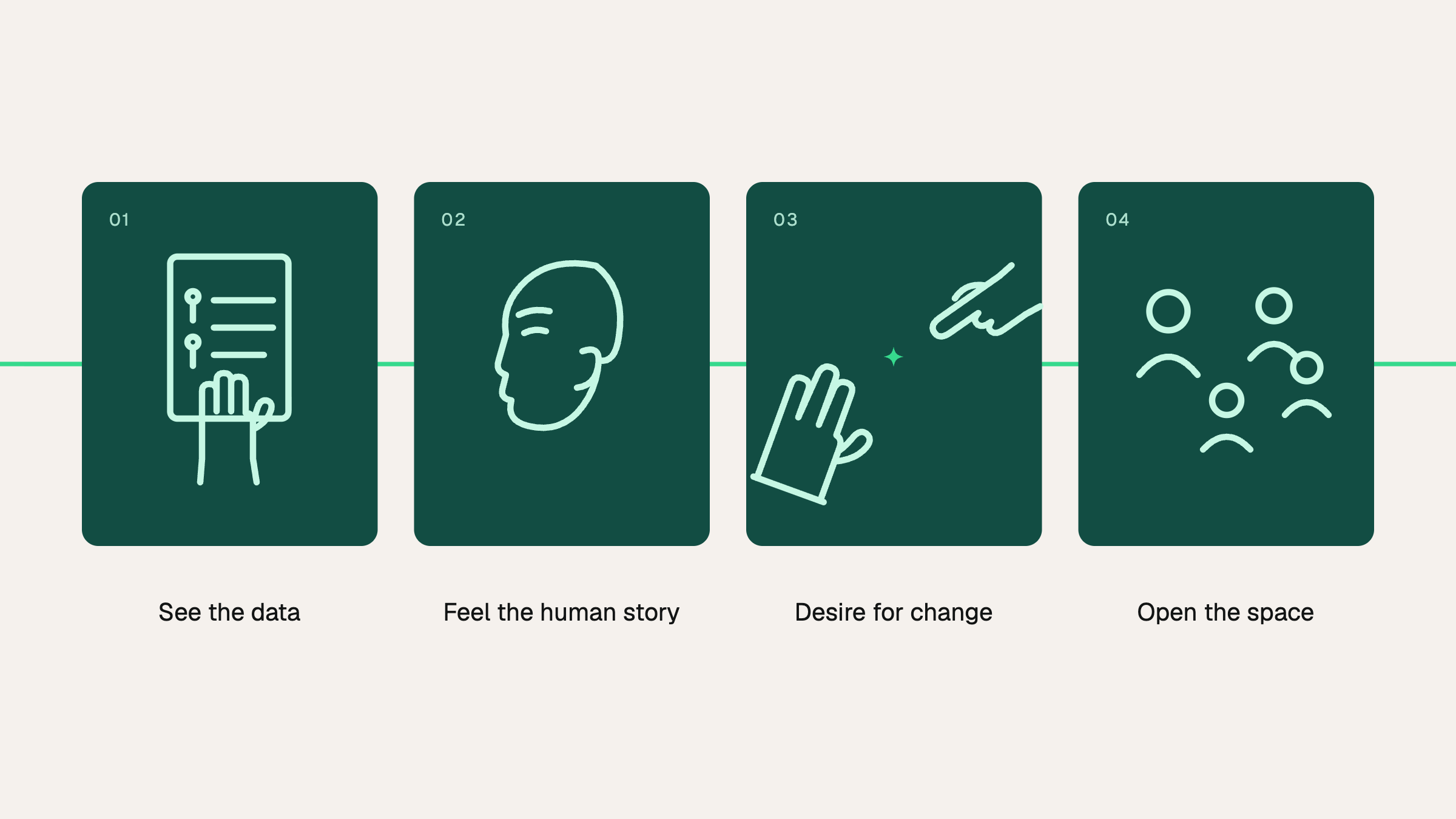
Then storytelling. Several leaders wanted to talk about their own mental health, and we arranged sessions over the following months for each of them to share how they had come through it and how they continued to manage.
Then prevention. Leaders asked to learn how to recognize early signs. We ran sessions for leaders and for employees, and built structured support for people returning from extended leave.
None of that was in the plan. It came from the room.
Something had shifted, but the survey was still telling us something uncomfortable. Company benefits were rated well. Individual leaders were not creating an environment where people could do their best work.
That is a harder message to deliver, because it is not about policy. It is about individual behavior, in a room full of individuals.
So we brought more data and more stories, in two forms.
Imagine an art gallery, but instead of artwork the walls hold statistics and quotes from employees describing what it is actually like to work here. Leaders walk through with a coffee. No presentation. No speeches. No facilitator narrating what they should conclude.
The absence of narration is the design. Nobody argues with a poster. There is no advocate in the room to push back against, so the only conversation available is the one each leader has with themselves.
We ran this with a country leadership team and later with a global executive team. In both rooms, some version of the same sentence: we cannot allow this to be the culture of the place we lead.

A small number of employees, all strong performers, interviewed their colleagues and built composite portraits of what the year had actually felt like for people the leaders would recognize. Not case studies. Not testimony. Portraits, in the sense that you look at them and see a person.
Two choices mattered more than the content.
The first: the portraits were told by high performers. People the leaders already respected, whose competence was not in question. That removed the interpretation that would otherwise have been available, which is that struggling is what happens to people who cannot keep up.
The second: not every portrait was difficult. One showed what it looked like when the system worked, when a manager responded well and support was taken up in time. Three hard stories would have produced guilt, and guilt does not sustain behavior change past the following Tuesday. Something showing what good looks like gives the room a direction to move toward rather than only something to feel bad about.
The leaders gave those employees a standing ovation. Not for performance this time, but for the courage of carrying colleagues' experiences into that room.
A moved room is not the same as a changed organization. Feeling fades. What remains is what people said out loud in front of each other.
Two levels:

Most were modest. That is the point. The mechanism is not ambition. It is publication.
A private commitment is an intention. A visible one is a promise your team can see you keeping or not keeping. It changes what employees can reasonably ask for, and it changes what leaders notice about each other.
I want to be careful here, because this is the section where accounts like this usually over claim.
The stories made asking for help look like something a capable person does rather than an admission of failure. Use of support services rose. Short absences rose. Long ones fell. People were treating the problem earlier, which was the entire point.
Public commitment changes what feels permissible. People test it, find it holds, and tell each other. Leaders who took visible steps found more people wanted to work for them. Leaders who did not began to look different by comparison.
Not through policy. Leaders began asking for data updates unprompted. They shared progress against their own commitments. Peer expectation did work that no mandate could have done.
This is what becomes possible when leaders feel it rather than only know it.
Three things:
The organization did not have a mental health problem that needed a mental health program. It had a visibility problem. Leaders could not see what their own behavior was producing, and no amount of awareness content addresses that. Naming the problem correctly determined everything that followed.
Nobody in that room needed to become a more caring person. They needed to encounter what was happening in a form that could not be processed as a metric. That is a design question: which data, in what sequence, told by whom, with how much silence around it.
Every part of this could have happened privately and produced nothing durable. The gallery walk was private reflection, and it worked because what followed was public. The individual commitments held because they were visible.
And one honest caution. This work requires leaders who are willing to be moved. In that room, the appetite was real once the door was opened. Not every room has it, and where it does not, the sequence above will produce a well-designed session and no change at all. Reading whether the room is ready is the first judgment call, and it happens before any of this gets designed.