
Last time, I wrote about the conversation every working relationship should have: sitting down with someone you work with and agreeing, out loud, how you will work together.
Congrats if you had the conversation! Now here is the unfortunate news: Having that conversation one time changes (un)surprisingly little.
I have watched teams do this work sincerely. Agreements made, written up, even framed. I once led a team where we created this kind of agreement twice, two years apart, with real effort both times. We never came back to it either time. It did not hold up. Not because the conversations were bad, but because we treated them as finished.
An agreement you never return to is like a photograph. It captures who you were the day you made it. But then life happens: the project changes, pressures arrive, a new person joins, someone leaves, and the agreement stays frozen in week one, while the relationship organically moves on without it.
The first conversation creates the agreement. The returns are what create the alliance.
Here is the proof, and you will recognize it. Most companies ask, once or twice a year, in the review form: "How could your manager better support you?"
The box mostly stays empty. And when it is not, I will be honest about my own reaction. I have spent over twenty years inside these processes, and I have still felt my stomach tighten reading that box as a manager. Why did they not just tell me?
The honest answer: because nowhere in our relationship had we made that easy. Once or twice a year, in writing, in a system other people can read, attached to an evaluation. That is the hardest possible place for the truth to arrive. And often it is the only place the question ever gets asked.
Here is a simple test. If you are returning to the conversation regularly, that "suggestion box" should contain nothing you are hearing for the first time.
This is the part that matters, and it is smaller than you think. You do not need a new meeting. Use a 1:1 you already have, and take ten minutes:
If the relationship is new, come back sooner, after two or three weeks, while you are still learning each other. Once things settle, monthly or quarterly is enough.
Then answer them yourself, both directions, same as the first conversation. That last question is the one that empties the suggestion box.
Your first version will be a little generic. That is fine. The returns are what sharpen it.
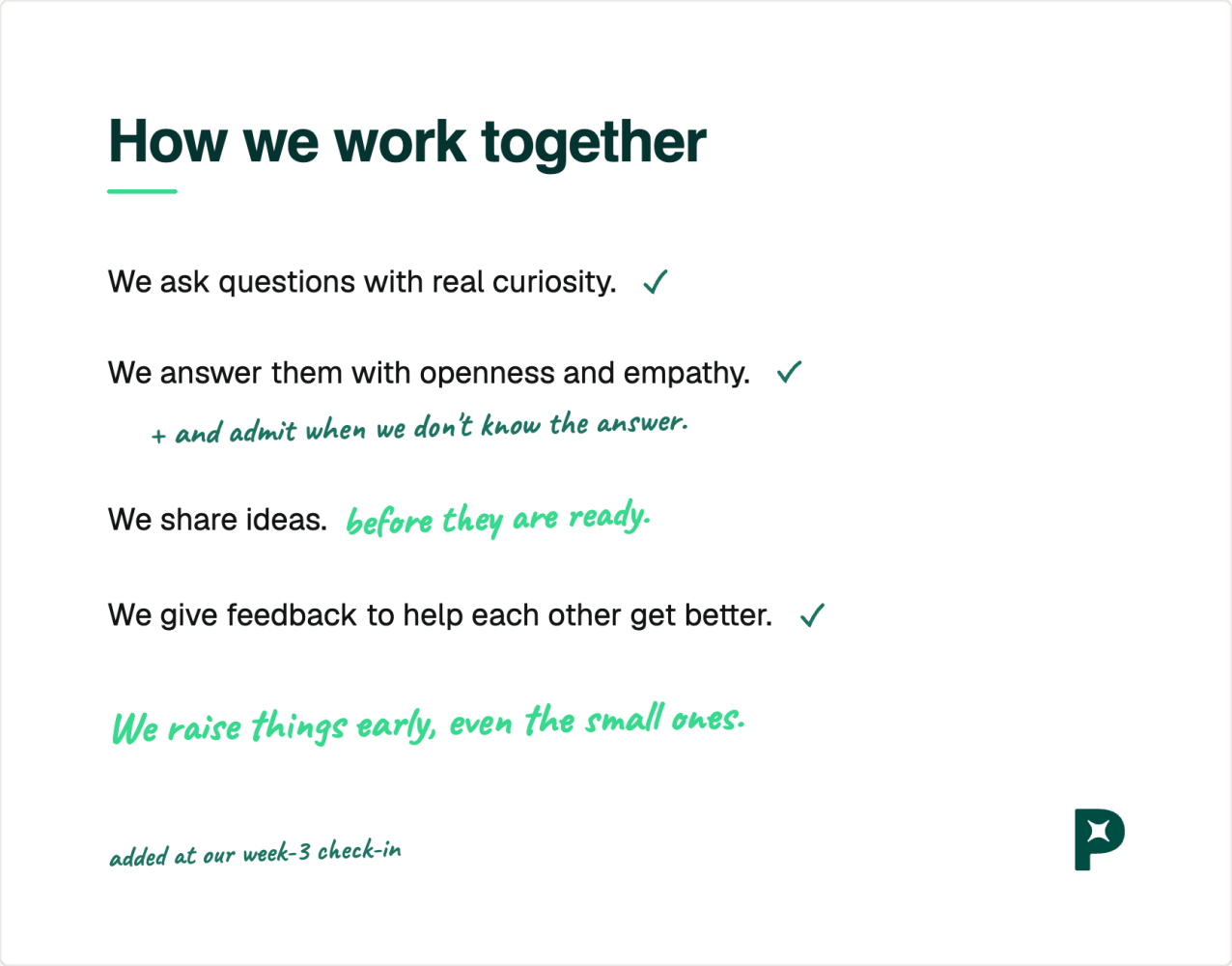
And when something has changed, change the agreement. Out loud. "We said we would share ideas. But I notice we both hold them back until they feel polished. Let us add something: we share them before they are ready." That one sentence is the whole practice. The agreement is allowed to move, because you both are.
I am building this return into my own working relationships now too. It is harder than the first conversation, and worth more.
We have been covering the 1:1 relationship, but what happens when we expand this to whole teams? Now, that is where this gets really interesting and where I will going next time.
If this has sparked some curiosity, I would love to continue the conversation at diane@ptminsights.com.