
I tell them: "Everyone is right... (and I pause here)... Partially." Then I ask,
"If this rule is true, what do you think is also true?"
They usually just stare at me. So I say, "Well, everyone is partially... (and I pause again)... wrong".
And they laugh because they get how obvious it actually is.
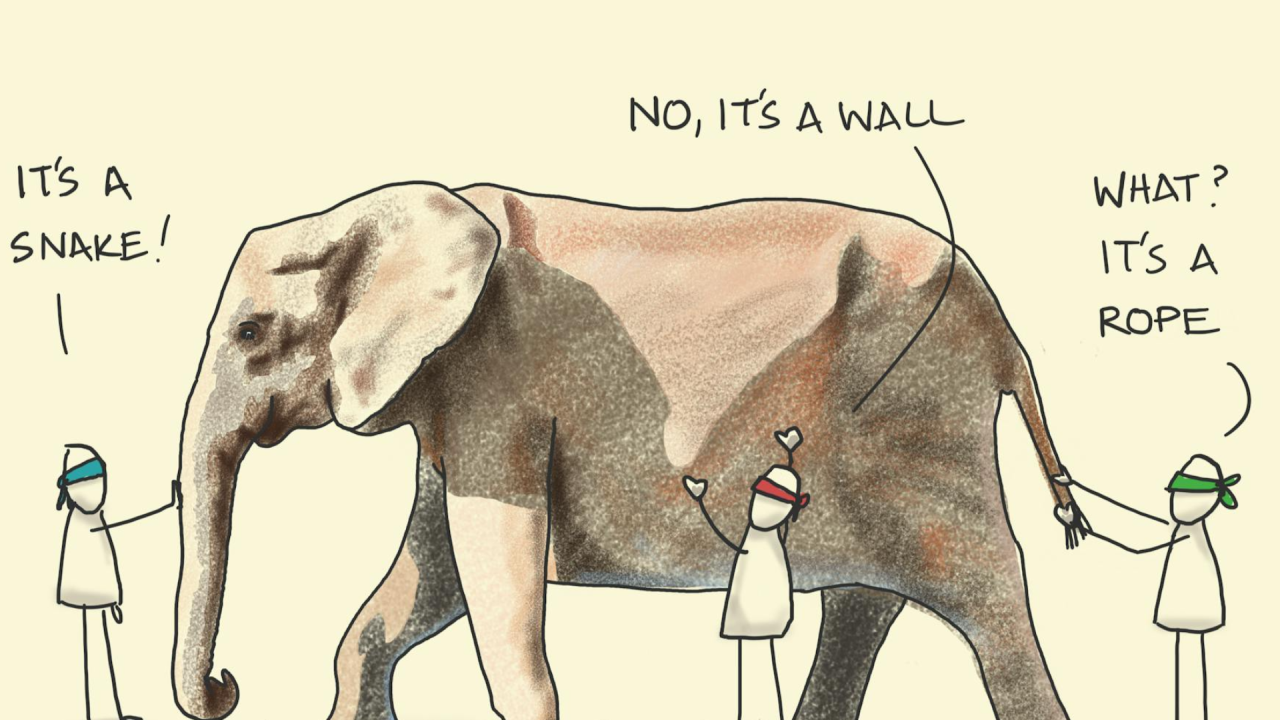
There is an old story that captures this. A group of blind men each touch a different part of an elephant. One holds the trunk and is sure it is a snake. One holds a leg and is sure it is a tree. One holds the tail and is sure it is a rope. Every one of them is right. Every one of them is also completely wrong. They are each holding a piece of the truth and mistaking it for the whole animal.
That is us, more often than we would like to admit.
As adults, as successful leaders, we feel confident in our intuition, in our ability to make decisions. Our value has come from being right. So it is difficult to have even a little bit of curiosity about something we feel incredibly confident about.
Let me be clear about what I am asking. I am not asking you to doubt yourself. I am asking you to be more curious about where your assumptions come from. If an assumption feels 100% certain, that is exactly the one to consider might be partially wrong. Especially when that assumption is holding you back, or causing you strain. Then why not consider it could be partially wrong? That could only let you breathe a bit more.
The assumption you are most certain about is the one worth looking at. Not to doubt it. Just to get curious.
I worked with a leader who had to communicate a near zero incentive bonus to one of their people. For any individual, that is a big deal.
They told me, "I think it went really well. I saw a flicker in their eye, and that was it." I said, that flicker is a lot. They said, no, it's not. You're not correct.
They were so certain there was nothing there that they could not even open to the possibility that something in what I said was accurate. And I think that was holding them back. They could not really influence or manage this person when they were unwilling to see what the reaction might actually have been.
This is why I love a 360. Most people, when they get 360 feedback, want to challenge it. They break it down into which group said what. Then, within the group, they want to know who said what. They go looking for someone to point at, instead of looking at the themes.
A great coach will stop that. This is not a set of accusations to sort through. This is the system. The system has these voices, and they are all partially right. So do not discount them. Ask instead,
If this feedback is partially right, what can I get out of it? And where might I be partially wrong about myself?
On the Leadership Circle Profile, I score high on Achieving. I lead with vision and strategy, and I have been proud of that.
But I also score high on Controlling. And the feedback shows me what that looks like in practice. I push people incredibly hard. They feel they cannot meet my standards. My drive, and my need for things to be near perfect, spills onto the people around me. That is the flip side, and it is something I really need to consider.
Here is the thing. I always kind of knew it. But without a 360 putting it in my face, I could just ignore it. The 360 does not let you ignore it.
This is the last piece on systems awareness. Next, I want to bring the whole series together.
If there is one thing I hope has come through, it is this. My aim has never been to find the most dramatic examples. It has been to notice the subtle ones, the signals in the ordinary day-to-day that are so easy to miss. The flicker. The nod. The thing someone did not quite say. That is the work I care about, and it is what I want to keep exploring.
If this has sparked some curiosity, I would love to continue the conversation at diane@ptminsights.com.