
The Willpower leader is the person everyone calls when something absolutely has to get done. Relentless, high standards, always delivering. Their greatest strength - their drive - is also what keeps them stuck. The Leadership X-Ray revealed the assumption underneath:
"My value is measured by what I deliver. If I slow down, things will not get done."
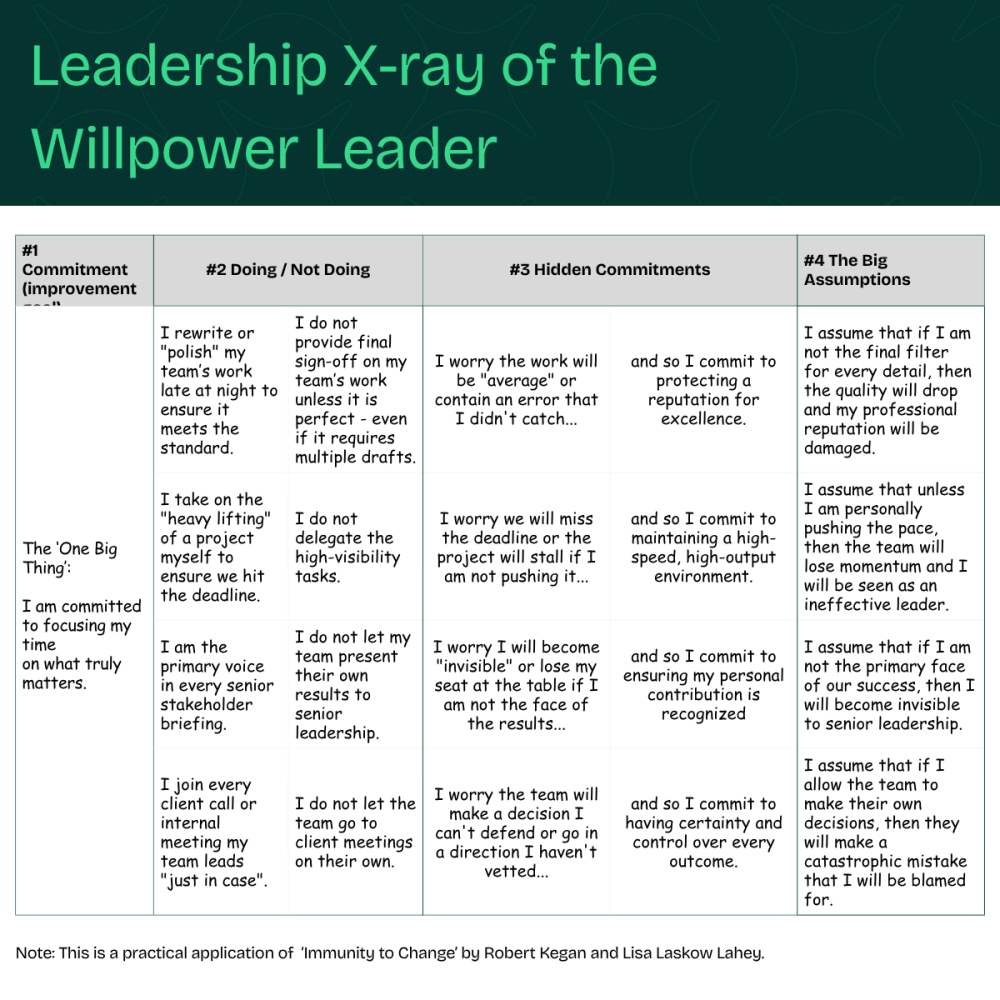
The most effective next developmental step is never a leap to the unknown. It is leaning into what is already there: building on your strengths to become a more purposeful, impactful version of yourself.
For the Willpower leader, that strength is delivering results. That is not going away. But right now, that energy is spread across everything that lands on your desk. You are probably responsible for all of it; that is not the question.
The question is whether everything deserves the same quality of your attention.
Because when everything is a priority, nothing gets your best.
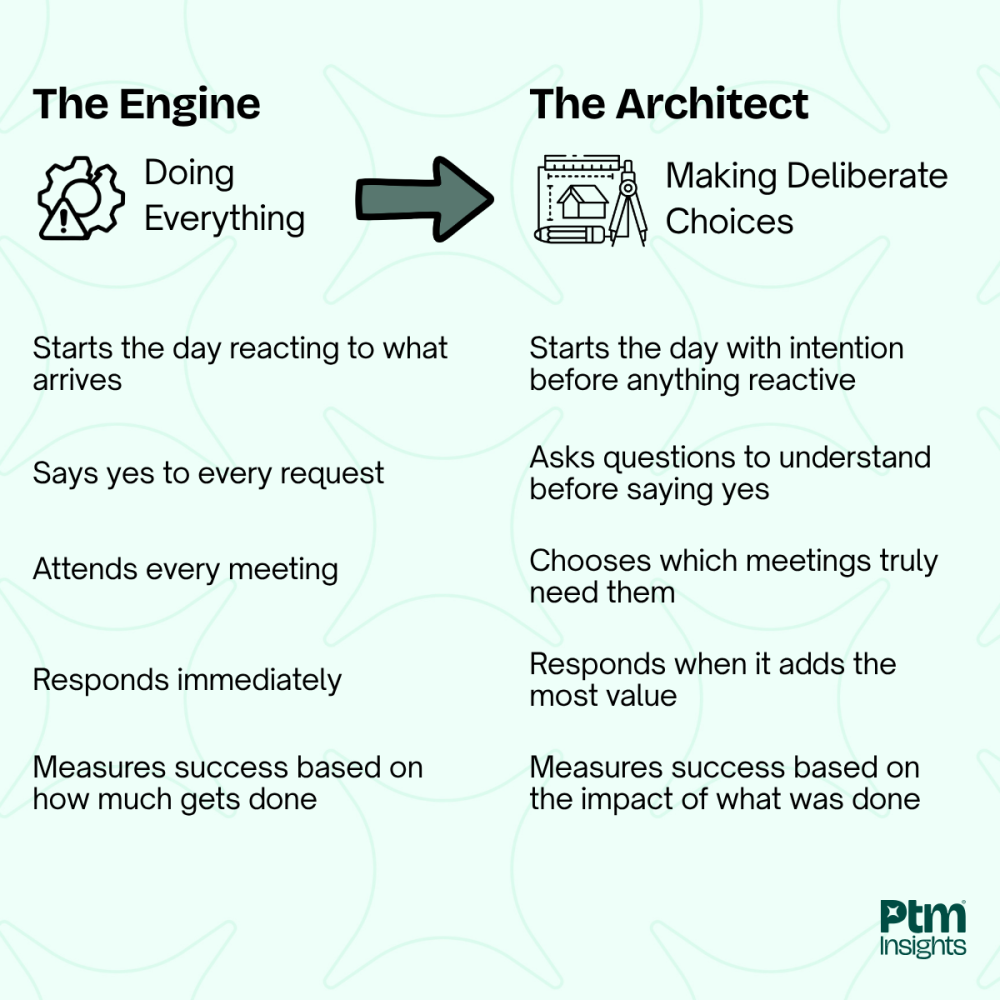
A Willpower leader running on their default setting fills every hour with execution. They are in every meeting, across every deliverable, the primary voice in every senior conversation. Stopping feels like falling behind. Delegating feels like losing control.
A Willpower leader making this shift asks a different question before they act:
Is this the highest and best use of my time right now?
They still deliver. They still hold high standards. But they are choosing where to direct their energy rather than simply absorbing everything that arrives.
The shift is not from working hard to working less. It is transforming from being the engine to being the architect.
The High Impact 90 is designed to create a direct experience of what this shift feels like and collect real data about the assumption that busyness = value.
The experiment has three parts:
#1 Monday Morning: block 90 minutes. Before email, before Slack, before anything reactive — protect this time. Phone off. No exceptions.
#2 During the 90 minutes: find one thing and do it.
#3 End of week: review the data. Before the week closes, spend 10 to 15 minutes with these four questions:
Write the answers down. They are your data.
Before you begin the next High Impact 90, take two minutes to check in on last week.
Did the one thing move forward? Is it still the most important thing this week... or has something shifted?
Then repeat.
Most leaders find the first week genuinely hard; narrowing to one thing feels almost impossible when everything feels urgent. By week two, something typically overrides the 90 minutes, which is data in itself. By week three the one thing starts to move in a way it never did when it was competing with everything else. And by week four the comparison is usually surprising;. the 90 minutes produced more genuine progress than the rest of the week combined.
The experiment does not instantly dissolve the assumption. But it creates a crack in it. And that crack is where the real work begins. You begin to understand what the data is telling you about the belief underneath, and what it would take to shift it sustainably. Please understand, this will take some time and is rarely a journey anyone navigates well alone. But it is completely possible and during this experimentation, you will begin to feel a new sense of relief and a joy for how you are spending your time.
In my next article, I will walk through the same process for the Heart leader, whose next developmental step moves from seeking approval toward building genuine, reciprocal relationships. Same goal. Completely different experiment.
If this resonated, I would love to hear from you in the comments. And if you are ready to design your own experiment, reach out at diane@ptminsights.com.